
Uday Kumar Varma
A brief and unscheduled visit to Tawa reservoir turned out to be a
memorable experience. The impounded water of Tawa dam has created a
sprawling magnificent lake, dotted with islands of varied sizes and
shapes.
But it is the sumptuous serenity and the trance-like tranquillity that
defines this place. Unsullied by the visitations of affluent but
unruly travellers and tourists, and comparatively untouched by modern
means of disruptive communication, the sights and sounds of this place
are a feast to the senses and a manna for the soul. But above all, it
is an ensorcelling slice of bounteous nature where peace is profound
and silence soothingly eloquent.
Transfixed and mesmerised we stood at the parapet of the elevated Guest House.
The Lake
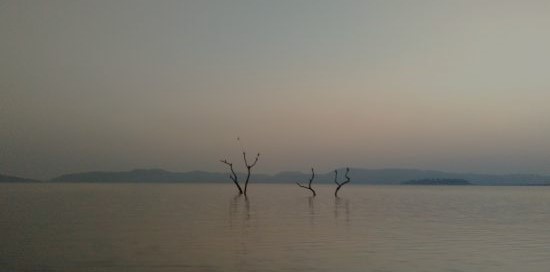
The ensorcelling sight of the vast expanse of water spread out before us was as rich a visual repast as was the verdant ring of hills surrounding the huge lake, casting dancing reflections on its mirror like surface.
The moon was slowly rising over the eastern horizon. The thin sliver of moon had made its soulful appearance and was by the minute gaining in size and luminescence.
Soon, the rays of a silvery moon began to descend on the placid waters of the lake. As if to welcome and embrace them, the silent and tiny waves began to rise, first imperceptibly and then visibly. The heaving of the bosom of the passionate waves was sensuous and sensual. And the sight was indelibly etched in our memories.
Tawa Reservoir
The lake I am describing is in fact, a reservoir created by impounding the fast flowing waters of Tawa river near Hoshangabad(Narmadapuram) in Madhya Pradesh. Tawa is a tributary of river Narmada, originating somewhere in the district of Chhindwara descending through thickly forested Betul district before entering Narmadapuram district of Madhya Pradesh.
The work to construct a dam on Tawa river began almost 65 years ago, way back in 1958 soon after the new state of Madhya Pradesh was formed in 1956 integrating vastly disparate regions like Madhya Bharat, Mahakoshal, princely states like Gwalior, Rewa and Bhopal; and the far-flung and wildly sprawling Chhatisgarh. That it took close to two decades to complete this major irrigation project reveals the fledgling competencies of the state as also the challenges of construction.
A Magnificent Boon
But once the project was completed, it proved transformative for the state. Primarily an irrigation project, it was designed to irrigate roughly 2.50 lakh hectares mainly in the district of Hoshangabad, which now comprises of the two districts of Narmadapuram and Harda. The irrigation potential of the reservoir is now almost fully harnessed. The reservoir, in addition to principally irrigating Rabi crops also provide water for summer pulses like Moong.
That the project over the years has made this region metamorphose into a pocket of affluence and prosperity and has in turn, helped the state to grow economically, is only one aspect of the benevolence of this scenically captivating project.
A private sector hydro-electric generation plant with the help of RSWI, Canada was also set up in 1998 on the left bank to utilize the tailrace water for irrigation purpose. The two units of 6.75 MW each were set up by a private entity and a successful example of a partnership mutually beneficial both for industry and the state. This project is, however, known for being completed in a record time of just 22 months.
The reservoir has a catchment area of almost 6000 square kms and when fully filled can rise up to 357 meters above mean sea level. It impounds 2311 million cubic meters of water and on an average retains close to 2000 million cubic meters. This extensive spread of water has permanently raised the water table all around and redefined the scenic quotient of the place.
Spread over an area of 225 sq km or 87 sq miles, the reservoir is dotted with several islands of varying sizes. Many of them are very small but some do have the possibility of being developed as promising pockets of leisure and pleasure.
The place is fast emerging as an attractive tourist destination. Several facilities like a cruise, a comfortable house boat and a resort already exist while a host of other facilities focusing on water sports seem to be in the offing. That the reservoir forms the western boundary of Satpura National Park and Bori Wildlife Sanctuary places this place in a uniquely advantageous position to grow into a terrific tourist destination of unparalleled potential and prominence.
A Sad Note
If one stands on the shores of reservoir and hears the gentle sounds of lapping waters, the strains are those of joy and contentment. And yet if you care to linger a little longer, you may detect in that eloquent silence some muted and muffled notes of sadness and regret, and a quiet pain rhythmically emerging from the pulsating waves. If one cares to pay a little more attention, there is a silent but plaintive urge and submission. These muted voices are those of the thousands of men, women and children who sacrificed their home and hearth so that the reservoir could be created but did not get their due. It is an impotent protest that continue to fall on deaf ears.
A planned and ambitious effort to develop this area and create employment opportunities particularly to families of those who were displaced on account of the dam, may, to some extent, address the injustices and compensate them for a deal that was both inadequate and less than fair to them.
The thought was sobering. The region does owe its rising affluence to the sacrifices made by them. Equity demands that some fraction of this prosperity must devolve on such families whose lands now impound the waters that have transformed the present and future of the people who have received the boon of a generous irrigation.
The remaining part of the evening was a bit depressing. No joy is ever unadulterated, that is the law of nature.
The Morning
But the next morning revived our spirits. The silence and the serenity was captivating. The sun effectively masked by the floating fluffy clouds did not spread the usual brilliance associated with the celebrated sun rise of this place. The usual pink, orange, red and yellow that slowly dazzle the eastern sky were missing but what slowly unfolded was even more memorable. The silvery grey of the sky was ever so lazily giving way to a reluctant day light.
For a change, the sun seemed effete and tired like a lover who has spent a long passionately amorous night and unwilling to set out for his daily chore. The reluctance, though, did not stand in the way of his unfailing duty as he set out on his long journey.
The transition was ethereal. The soft cool morning dispersed a brightness that did not bring with it the usual sharpness and heat that soon forces the beholders to retreat to shadier stations. The soothing breeze laden with moisture of a rainy month provided an excuse to linger the experience. And only when the sun was quite up in the sky that we decided to leave the perch from where we had so delightfully regarded a divine feast to our senses.
And The Evening
Sitting in the veranda of the Guest House, I reflect on the previous developments relating to the construction and operationalising the dam, the toil and labour of workers, the dedication of the engineers and skill of masons and other people dealing with machines. I also visualise the physical inconveniences, the grave hardships and the emotional trauma of those villagers who had to get uprooted from their ancestral places where they and their forefathers were born and brought up just to ensure a better and brighter future. And I also thought of the prosperity and well-being that this dam has ensured since its construction.
Unnoticed and unknown to us, the day advanced and imperceptibly merged into a mellow evening.
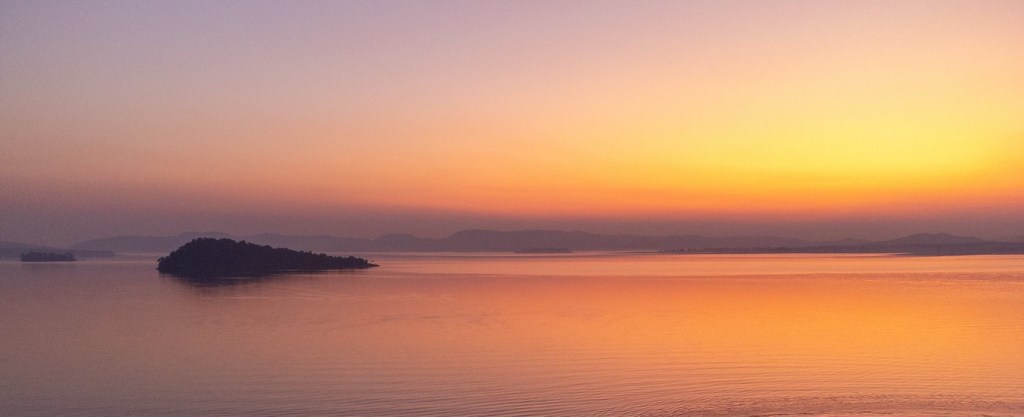
And then we noticed the sun coming back from the day’s toil, after performing a task that it has continued to perform since eternity, and shall continue beyond eternity, without failing even once. It seems tired, dissipated of its boundless energy. But the satisfaction of a day’s job well performed, glowed. Unlike the morning, the skies this time were alight with lusty hues of bright and joyful crimson, orange and red. Sadly, it began slowly losing its intensity and energy. The bright red gave way to dull orange, the orange became a pale pink, then grey with tinges of crimson, and then grey got darker and darker. And as a dissipated sun decided to take the final plunge, a peaceful night slowly descended.
Then Night
But the lengthening shadows did not bring sadness or depression, nor diminishing enthusiasm, nor the dilution in the bliss and joy of the moment. The night here is not stygian or sombre. It is profound peace, soothing serenity and trance like tranquillity.
Later as we retire to our rooms, a lulling joy overtakes us. Unspoiled by the hordes of visitors and unsullied by the onslaught of modern day communication, the place offers an experience difficult to describe and impossible to forget. Wondering about the mysterious ways of nature and how bounteous it has been to us, we slip into the soothing embrace of a deep sleep.
“Slowly imperceptibly, the night
Falls, quietly, unobtrusively,
Darkness envelopes all that is around
Cloaked in a shroud, magically bound
It neither scares nor subdues.
A mystical inexplicable peace
Suffusing, stilling the soul.
A strange somnolence,
I slip into deep sleep.”
Uday Kumar Varma, a 1976 batch IAS officer of Madhya Pradesh cadre, was Secretary Information & Broadcasting, member of the Central Administrative Tribunal (CAT) and member of the Broadcasting Content Complaints Council, a self-regulatory body for general entertainment channels. As Secretary I&B, he spearheaded the nationwide digitisation programme.
