
Uday Kumar Varma
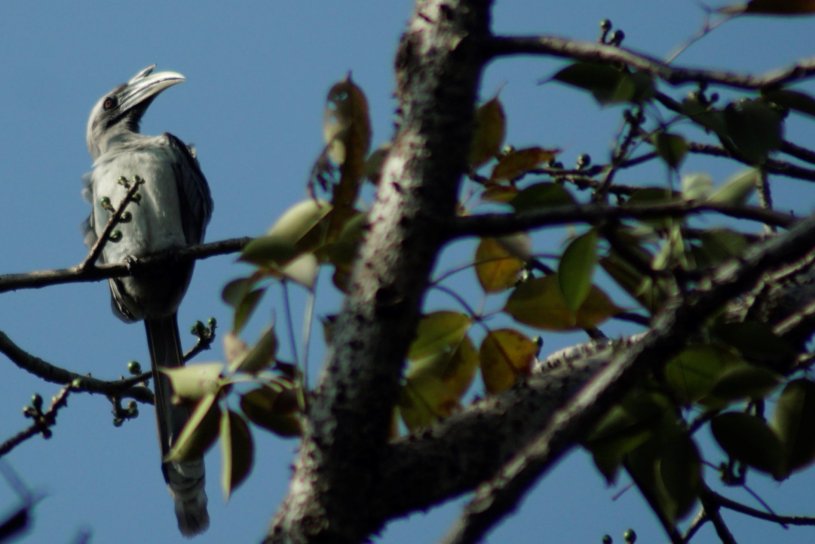
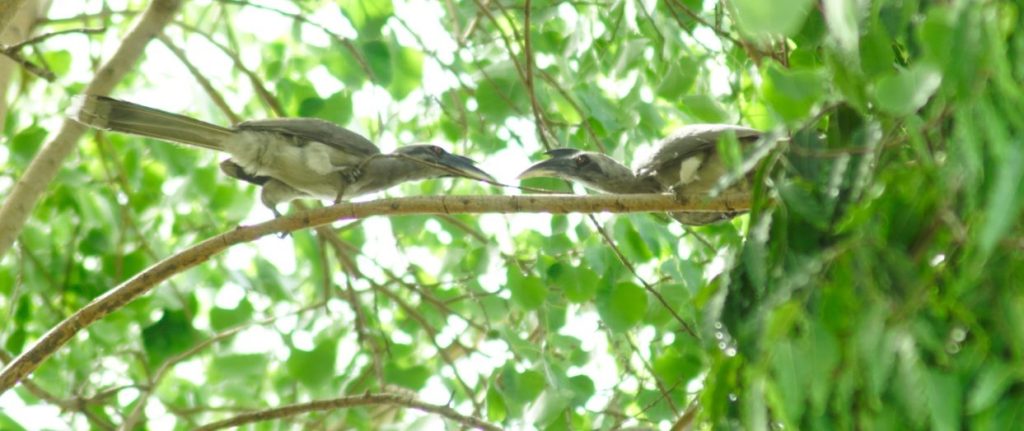
The world of Birds: Serene, close to Paradise: Sitting in the verandah of this beautiful colonial house replete with the grandeur and grace of tall, luxuriant, shady trees offering a setting and a serenity, close to a paradise, I hear the multitude of sonorous sounds emanating from the many trees. Many of them are sweet and captivating, some are somewhat harsh and raucous. Then I see the flight of a grey hornbill. First one, and closely followed by its companion. Compared to bulbuls and parrots, and treepies and orioles, hornbills are ungainly, and sharp and shrill in their call.
I began thinking of them, an ubiquitous denizen of this sprawling campus,never to be missed because of their size and sound.
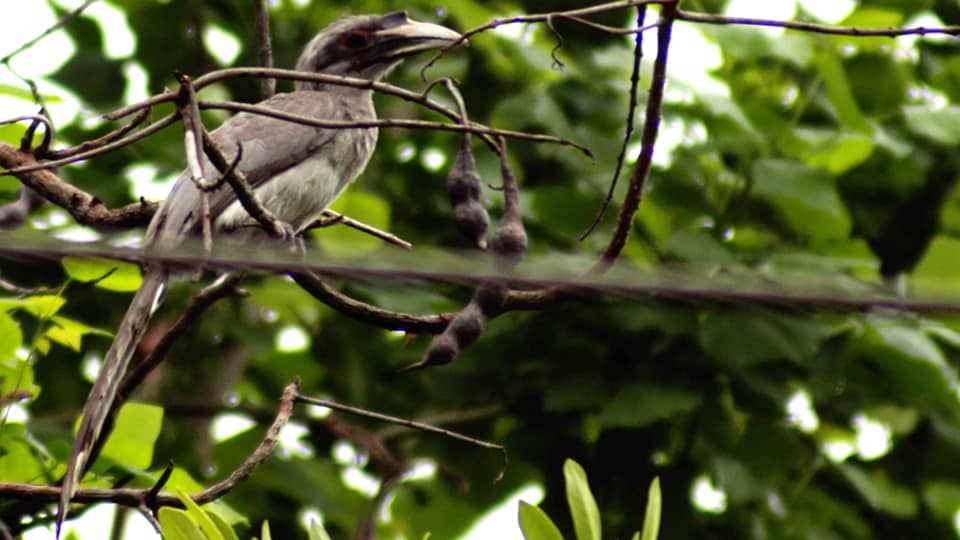
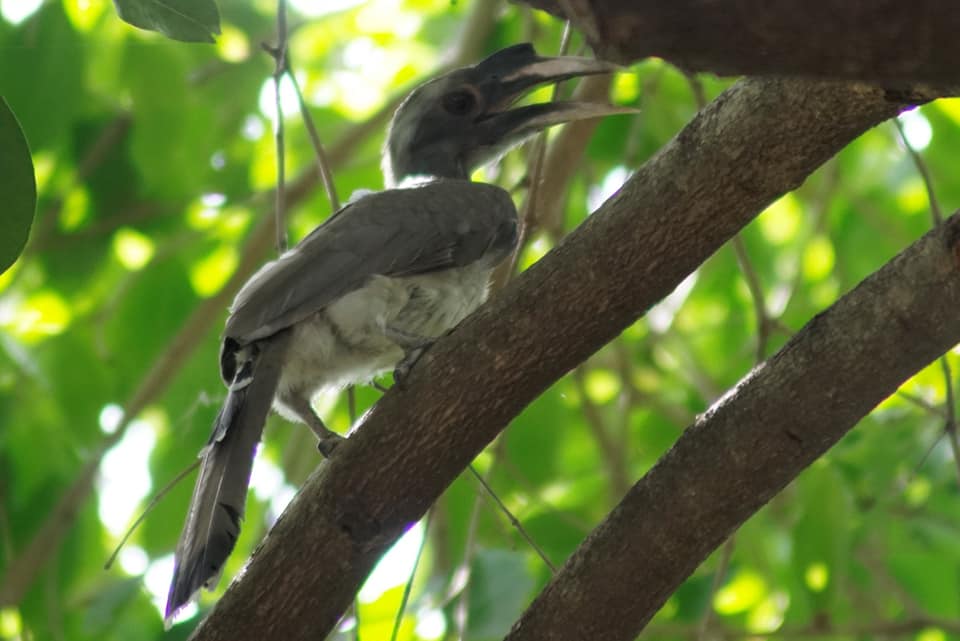
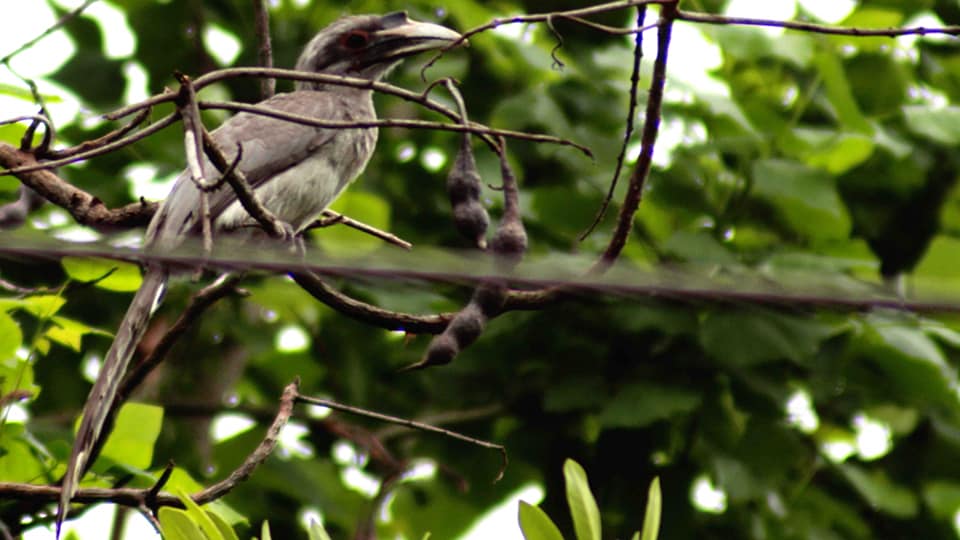
The Indian Grey Hornbill
If there are no hornbills
there will be no cedars,
And so many-other-trees,
And may be no man!
For, it is for them that it rains
still in the forests, in spite of man
Who keeps cutting trees
and hunting all that he fancies!

I may be denigrated as a bird that possess the strongest vocal cords and yet possibly the most shrill and strident voice. I may not be fancied as one of those birds that bring great delight to the beholder. And yet I offer a sight of unique beauty, grace and grandeur. As a large arboreal bird, a common sight in many households, I never fail to attract attention as my short desultory flights from one part of the garden to another present a captivating and unmistakable spectacle.
Admittedly I do not possess the sweet and magical voice of a Koel or a Hill Mynah, the spectacular brightness of the Oriole, parrot or peacock, the agility of the Drongo or the Robin, and the cultural salience of a Paradise Bird or Eagle. Yet, I possess a rare synthesis of many of the qualities that these best loved birds claim to possess. My call may belie a legitimate expectation of a sweet soothing strain.
Yet, the compensations that I offer instead, are many and meritorious. No other bird known to humans, play the critical role of seed dissemination, germination, and regeneration of trees as well, as I do. This is because I am mainly frugivores (fruit consuming) and can break up/swallow large fruits, and regurgitate the seeds without damaging, making me the perfect dispersers.
And I travel long distances in search of fruits and move these seeds to distant locations. My contribution, thus, to the continuation of life on earth can be better appreciated only by discerning and thoughtful minds.
It will be impossible to fail to notice that trees such as Premna tomentosa (a teak like tree), Putranjiva, Fern trees, Cedars, and even Sandalwood trees, some of the most significant medicinal and commercial trees, owe their regeneration to me.

These iconic trees that generate very few seeds and whose seeds are difficult to break out of their rather hard shells, depend almost entirely on me for their future propagation and survival.
The Disseminator and The Destroyer
I am often criticised and berated for being a great destroyer, for, I break, and pluck and bite much more than I eat. A fair criticism and I must tender a sincere apology to all those who genuinely feel offended, even sad, to find this destructive trait within me. But I also have an explanation, which though does not justify this aberrant behaviour, bring out the utter helplessness that possesses me as I sit on trees and try to nibble at its tender leaves, shoots or fruits and flowers.
The nature has for some inexplicable reason designed my bill in a mould that cannot bite selectively. My sharp and long and rather big bill compel me to bite much more than I need to consume. So, the tender shoots and leaves fall prey to my appetite and while I take only a small part of what I bite, much more falls on the ground giving untold sorrow to those who understand the value of conservation. But hold! do not write off the gratitude of the many smaller birds, insects and ants who look forward to these unintended gifts to their great relief and delight.
And yet, there is a design behind this apparently irrational and wasteful habit, which nature has compulsively imposed on me. The pruning that the trees receive in the process helps them to grow better. I wonder if any of the trees and shrubs that I inhabit were ever asked whether they find my act obnoxious and disgraceful or whether derive a definite advantage out of it. If the herbs, shrubs, and trees were able to respond to their tending by a caring gardener, that could perhaps be a fair assessment of my so-called destructive conduct. Not to forget that it also helps propagation and germination of some of the finest trees on earth.
Something about Me
Birds are not known to be modest. Look at the peacock, how it struts its colourful bright feathers; and who can ignore parrots who never tire of talking only because they have a scarlet and crimson beak, very shapely and sharp. But I adhere to modesty, despite possessing an uncommon beauty of both body and heart. I am tall measuring up to 24 inches or almost two feet, from beak to tail. My upper parts are greyish brown and there is a slight trace of a pale supercilium. My ear coverts are darker. The flight feathers of my wings are dark brown with a whitish tip. My tail has a white tip and a dark subterminal band. And which other bird has such remarkably red iris and the eyelids with curved eyelashes. My beak is adorned by a crown, short and pointed. They call it the casque. Such embellished and elaborate countenance is my privilege and pride.
I am almost completely arboreal, and very rarely descend to the ground to pick up fallen fruits. Occasionally in summer months, I do descend to enjoy a dust bath along with my companion.
A Lesson in Raising Family
I most enjoy my forays to ground when I am in the process of building my home and raising my family. Few of you would know how assiduously I build my home where I safely keep my female so that she can lay eggs and raise our children. The nesting season is April to June, and I am usually blessed with a clutch of one to five very symmetrical, beautiful white eggs. I usually nest in tree hollows on tall trees. After carefully selecting an existing hollow, I suitably excavate it to fit my requirements. My partner enters the nest hollow and seals the nest hole, leaving only a small vertical slit through which I feed her. The nest entrance is sealed using the excreta and mud-pellets that I collect from the ground all around and deposit it in the nest. While inside the nest, my female moults her flight feathers and incubates the eggs. I provide the nest inmates, the mother and the fluffy, cuddly, soft, furry chicks, with a steady supply of bark pieces to ensure that the excreta is removed from the nest by absorption and adsorption and to help maintain the micro-climate within the next cavity. The regrowth of the female’s feathers coincides with the maturity of the chicks, at which point I and my female together get the nest broken open.
I sincerely believe that many birds and animals and possibly humans as well, will do well to take a leaf or two from our conjugal endeavours in raising our progenies.
Aerial Jousting
Humans take pride in sports and activities showing their physical prowess. One such sport is jousting. It is a serious sport, linked with honour and self-esteem.
Losing or winning a jousting encounter may cost a life on one hand and may make you fall from grace on the other. But do you know that this manly game has been adopted by humans after watching us playing it since time immemorial. We call it aerial jousting, which is complemented by bill-grappling. It’s an exciting sport very seriously practiced and occasionally fatal. It helps us find our place in the hierarchy and establish a leadership so typical of our community.
And I make fun of Humans
Humans fancy themselves as a superior creation and claim to be at the summit of evolutionary pyramid. They boast of being more intelligent than every other living being. Possibly they are. They observe and study every other plant and animal and bird and insects and write books about them and publish interesting and often obtuse research papers. We, birds, also observe human beings, for their unreliable ways and ingrate behaviour dominated by their selfish and petty interests and whims. And perhaps we observe them more closely than they do.
And we have our moments of fun too. On summer afternoons, we often descend on a dusty road and pretend to be immobile and still. Noticed and their curiosity getting better of them, they come close to perhaps claim us or capture us. And as soon as they are in a touching range, we take a flight completely startling them to their annoyance and occasional amusement. These moments are greatly relished and savoured by us.
With over 54 species across the globe, and at least 9 of them to be found in every part of India, except the wettest and the driest regions, we offer that aspect of a diversity that is both charming and charismatic. But for us, some of the most precious trees in the world like Sandalwood and Cedar may have become extinct millennia ago. In our ugliness and ungainly body is nestling a warm and benevolent heart, and a fervent uninhibited gratitude for the bounties of nature.
Benevolence Thrives Within Me
Let me conclude with a poem that I composed in my mind long ago, sharing my dilemma, voicing my predicament, and offering an honest impersonal evaluation.
In verdant woods, where echoes dwell,
A call resounds, both harsh and swell,
With heavy wings, in lowly flight,
A silhouette, perched out of sight.
Who art thou, bird of sombre hue?
Some may deem thy form askew,
Yet hidden truths lie deep within,
Unveiling purpose, we shall begin.
Thou wreaketh havoc, so they claim,
Scattering debris, a path of shame,
Yet as thou percheth, biting, gnawing,
What purpose hides within thy mawing?
Though negative perceptions sow,
Beauty thrives where few may know,
For deep within thy rugged guise,
A tender heart doth softly rise.
Inquire of trees with seeds so tough,
With kernels striving to break through,
Or those with windows small and rare,
Seeking rebirth, the world to share.
Behind thy visage, unrefined,
A soul compassionate, intertwined,
Though brash my words may sometimes be,
Benevolence thrives inside of me.
Uday Kumar Varma, a 1976 batch IAS officer of Madhya Pradesh cadre, was Secretary Information & Broadcasting, member of the Central Administrative Tribunal (CAT) and member of the Broadcasting Content Complaints Council, a self-regulatory body for general entertainment channels. As Secretary I&B, he spearheaded the nationwide digitisation programme.
Adver
 This is News