
Tapan Misra
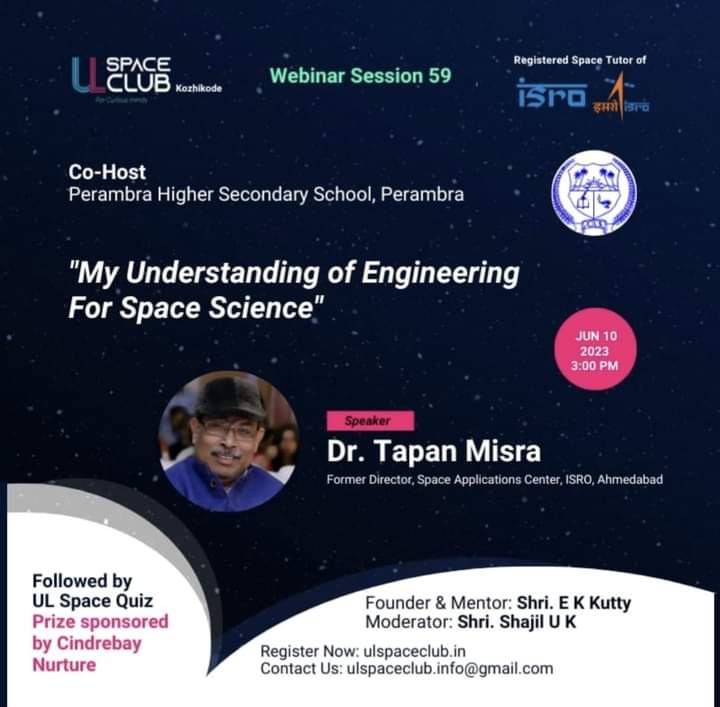
For any scientist, specially for someone not so eloquent, interaction with school students is potentially an intimidating one. Their curiosity knows no bounds, their questions can take any direction, with the potential of exposing human limitations of a scientist’s understanding and knowledge. Still, I could pick up courage to participate in a two-hour interaction with school students from across Kerala, under the aegis of UL Space Club, Kozhikode. I must admit that I enjoyed thoroughly, fielding the curiosity of bright young minds on all aspects of space science, oblivious of occasional exposure of vast tracts of my ignorance. I fervently hope, students do have a reciprocatory opinion.
I submitted that the complexity of the nature and the cosmos has an eerily underlying simplicity. The myriad variations of human races, their achievements and failures, their capacity to explain and describe the unknown, their ingenuity, rise and fall of civilisations over thousands of years have all their secrets encrypted in minute variations of 23 pairs of chromosomes in human cells.
Take into consideration scientific laws such as the laws of gravitation, Coulomb’s law, Planck’s law, Newton’s laws of motion, Keppler’s laws, Einstein’s mass energy conversion laws, laws of thermodynamics and Hubble’s law of expansion of universe. They have one common thread. They are deceptively simple, but they explain umpteen complexities of the universe, predict origin and annihilation of mighty galaxies and precisely determine the trajectory of rockets, planetary bodies and orbital positions of man made satellites. And many more mysteries of the universe.
My limited experiences over four decades in space science have taught me that engineering of high reliable space systems should take cue from the nature – abhor complexity, embrace simplicity, in conception, explanation, planning and implementation. I shared my dominant experiences of analyses of failures of many space systems. Mostly in these instances of failures, the root cause pointed to the fact that the engineering was more often than not, a convoluted one rather than a straight forward one and many a times the test anomalies were brushed under the carpet, rather than seeking cogent explanations.
The last but not the least, as aspiring space scientists, students need to avoid the tendency to compartmentalise science and engineering into tribal groupings rather than approaching them holistically. After all, like nature, you cannot incarcerate science in isolated brackets.

The author, Tapan Misra, is founder of SISIR Radar. He is a distinguished scientist. He was Director Space Applications Centre and is recognised globally as father of Indian SAR (Synthetic Aperture Radars)
 This is News