
Dr A E Muthunayagam
Water is an essential requirement for domestic, industrial and agricultural use all over the globe with ever increasing demand. Ocean has about 94% of global water, but not fit for these uses because of about 4% of dissolved salts in it. Over the years Desalination has provided solutions to meet partial ‘water needs’ across the nations.
Desalination is the process of removing salts, other minerals and contaminants from
sea water, brackish water, effluents, etc and is an increasingly common solution to obtain
fresh water. Desalination processes are mainly based on thermal and membrane technologies.
Thermal desalination processes include multi effect distillation (MED), multistage flash
(MSF) desalination, vapour compression (MVC or TVC), and solar desalination (SD).
Membrane based desalination processes include reverse osmosis (RO) and electro-
dialysis (ED).
Thermal and reverse osmosis (RO) are currently the two major desalination processes in use, accounting for 34.2% and a 63.7% of the total capacity produced, respectively. It is noted that RO generates a residue with a high salt concentration called brine which is of concern from environment consideration.
In 2014, the Institute for Globally Transformative Technologies at Lawrence Berkeley National Lab, California, USA, published ’50 Breakthroughs’- Critical Scientific and Technological advances needed for sustainable global development. It is interesting to note in the publication that the first among them was a new method for desalination: scalable, low cost, and using renewable energy. The publication further pointed out that Water scarcity is one of the most critical problems the world is facing today, and this problem is likely to get significantly worse in the coming years.
The challenge now is to evolve an innovative process, system and technology to desalinate a portion of available huge quantity of the saline water from the Ocean and utilize, the renewable solar energy in situ. For this, sustainable, environment friendly, offshore, economical (TBC), reliable, integrated desalination system which does not require external power supply for operation by generating in situ all power required from the solar energy stored in the upper strata of the ocean is the answer.
SYSTEM CONCEPT
Experts have been talking of this possiility for several decades, but no single system is yet operational on an industrial scale in the commercial sector. The system that has the potential of scaling up output to meet industrial and other demands is called ‘Integrated Desalination System’ (IDS). It has two major subsystems; the firs is ‘Ocean Thermal Energy Conversion (OTEC)’ for power generation and the second is ‘Low Pressure Distillation (LPD)’ for desalination.
As it is known, Ocean covers about 71% of earth surface and is the largest Solar Energy
collector which stores the Solar Energy in the upper strata of the Ocean, resulting in a
temperature difference between upper strata and depth. Both OTEC and LPD use the warm
and cold waters from the ocean for their operations. [ download attachment and check – A brief note on OTEC and LPD, presented in attachment No 1 and No 2].
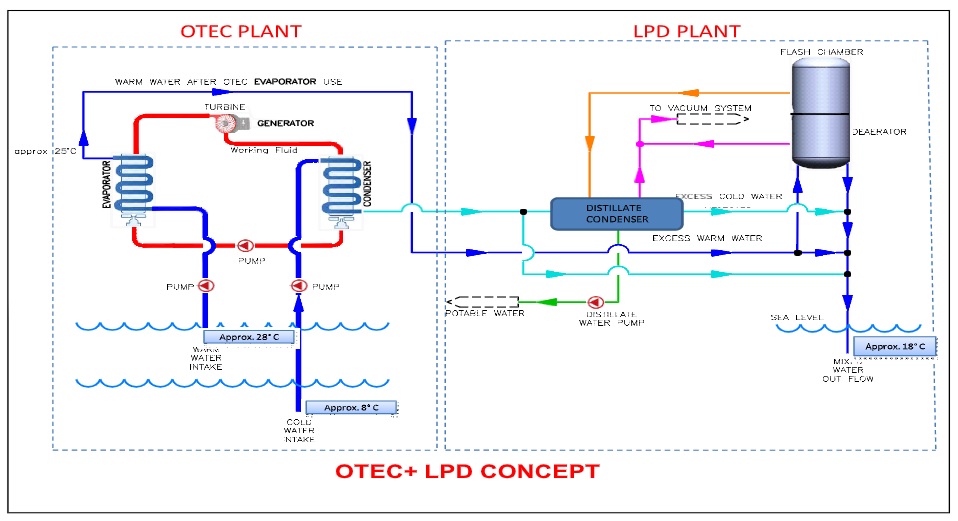
As can be seen, OTEC takes large quantities of warm saline water from the upper strata of ocean as energy input to the ‘Power generation thermodynamic system’ to produce power and also large quantities of saline cold water from the ocean depth as sink to absorb rejected energy. After producing power, large quantities of both warm and cold saline water are discharged from OTEC. The discharged warm saline water is used as feed water to the ‘Desalination thermodynamic system’, where salt-free water vapour is generated in a low pressure vaporizer and subsequently condensed as desalinated water in a fresh water condenser, using the cold discharge from OTEC as cooling water.
The schematic diagram of the layout of Integrated Desalination System is given
below:
DESALINATION PROGRAMS IN INDIA
In India, we have two large capacities (100 MLD) operational desalination plants near
Chennai; one at Minjur (2010) and other at Nemmeli (2013); both are based on RO
technology. Some more large plants, based on RO technology, are under construction and
some are being proposed, also on RO technology. It must be pointed out that desalination RO plants are available in a large range of capacities, starting from small plants for domestic use to larger industrial plants, serving industries and large communities. The effluent, discharged from the RO plants are pollutants and need to be treated adequately before discharge into the ocean to ensure safe marine environment and marine life.
In addition to the operation of a large number of imported desalination plants of different capacities, primarily based on RO technology, indigenous technology developments were initiated more than two decades back by MoES (former DOD), BARC (DAE), DST, and academic institutions KITS, and IIT-M.
Major initiatives in India on Desalination are taken up by MOES. All details are not available in public domain. [With available information, a brief note on the desalination initiatives and performance of MoES over the last two decades are presented in Attachment 3].
It is observed that MoES has addressed three types of programs; the first one on ‘Shore
based desalination system for islands, the second one on Offshore desalination system for main land, and the third one on Utilization of industrial waste heat for desalination. Based on the available observations, there is need for focused attention on following:
- For Shore based desalination systems in islands, it is essential to evolve, develop and commission sustainable Thermodynamic Systems, using the renewable solar energy stored in the ocean.
- For Offshore desalination system for main land, it is necessary to develop and commission the Integrated Desalination System, which is offshore, environment friendly, sustainable, and does not require any external power supply for its operation by generaing all power required for operation in situ from the solar energy stored in the ocean.
- For utilization of industrial Waste Heat for Desalination by NIOT it appears that the technology is available but the Management System and Procedures need modifications to execute time bound projects on a project mode.
A long way appears ahead for MoES to meet the ‘Water Needs’ of the nation. BARC of DAE has been engaged in R&D on desalination, primarily to meet their own needs for reactors. BARC has developed a 1.8 MLD capacity RO plant and also a 4.5 MLD capacity MSF plant. They are operational at IGCAR, Kalpakam. In addition, a 9 MLD RO plant was also established at IGCAR for their needs. BARC continues R&D and has developed membrane indigenously for RO plants and is under production in external industry.
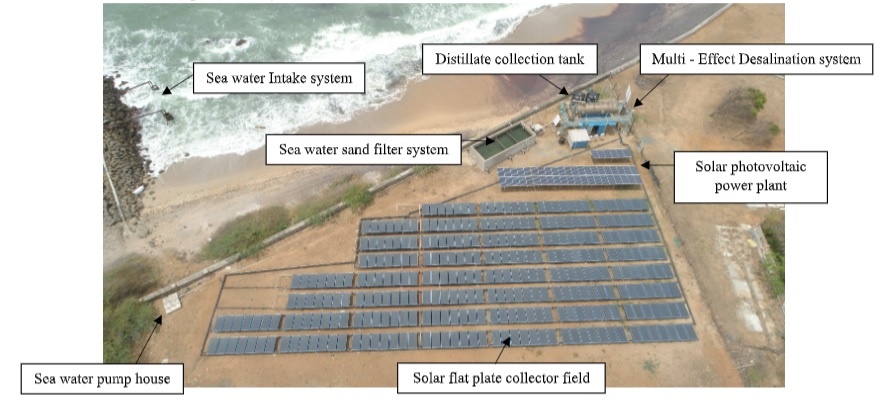
Prof A Mani, Mechanical Engineering Department IIT-M has initiated R&D on Solar based Multi Effect Desalination and established a plant of 10000 liters per day capacity at Kanyakumari. [A brief note is presented in Attachment No 4]
RECOMMENDATIONS
- Desalination plants intake large quantities of saline water, desalinate a portion and discharge a larger portion of the intake water back to the ocean. Hence establishing desalination plants offshore could have advantages over land based plants both technologically, logistically, environmentally and economically.
- Establishing OTEC and other offshore renewable energy sources have merits for the efficient operation of Offshore desalination plants
- Though Government agencies and academic institutions in our country have initiated programs decades back on Desalination, on date, India does not have any indigenously developed operational desalination plants to meet the ‘Water needs’ of the nation. The existing large capacity industrial desalination plants, operational in India, are based on RO technology.
- The RO desalination plants are power intensive, requiring large power supply for operation. Towards this, dedicated large capacity power plants are necessary.
- Further RO plant generates a residue with a high salt concentration, called brine, which is of concern from environment consideration. The effluents which are pollutants need to be properly treated before discharge back into the ocean. Some concern is raised about the adverse impact on marine life in the neighbouring fishing village near Nemmelli RO plant. (To be confirmed).
- The status of desalination technology and demonstrated capability for establishing large capacity industrial desalination plants are of great concern to our nation. To save time and leap frog to meet the ‘Water needs’ of the nation, it is necessary to establish Programs on desalination with focus to establish operational industrial desalination plants in project mode as being done by ISRO with technology transfer on a selective basis.
- Makai Ocean Engineering Company (MAKAI) of USA is the leader in the world on ‘OTEC technology’. MAKAI has commissioned and connected the first OTEC plant to US grid in 2015. One had been interacting with MAKAI that even expressed willingness in 2018 to be the Technology provider and participate in Indian desalination project off east coast in Chennai. [Copy of the MAKAI communication is presented in the Attachment No 8].
- The Integrated Desalination System with OTEC+LPD, explained above is offshore, sustainable, environment friendly, does not require any external power supply for operation and incorporates ‘power generation’ sub system and ‘desalination’ sub systems which are already demonstrated independently in a small scale. Hence, it is an obvious choice to proceed to establish a pilot project of 25 MLD capacity (TBC) Integrated Desalination plant along the southern East coast of India with MAKAI as a Technology provider. Larger program can be evolved subsequently.
- Without disturbing the ongoing desalination programs in Government, the Pilot project could be established by a Private industry under BOT scheme and transferred to any one of MoES, MNRE of GOI and MAWS of GoTN. The mode of establishment and transfer shall be decided jointly by the above three ministries.
- The Administration and Finance Management systems for the autonomous Pilot project shall be decided by a high power committee with representatives from MoES, MNRE, MAWS and Experts from Industry and Academia
- A special purpose vehicle SPV-RED shall be established to plan, establish and operate the 25 MLD Pilot plant. Necessary orders shall please be issued by MoES,or MNRE,or MAWS.
The author, Dr A E Muthunayagam, Former Secretary Department of Ocean Development, Government of India, and Founder Vice Chancellor of Karunya University, initiated R&D on Desalination in 2001 after his superannuation as Secretary to GoI. He established a laboratory and associated the students and faculties in his research efforts. He received two SERC grants from DST, GOI. Based on his work, he published two articles in international journals. For his work on Low Pressure Distillation (LPD) for Desalination of sea water, he was granted an Indian Patent No 19696 of 2003. [A brief note on Desalination activities at Karunya Institute of Science & Technology (KITS) during 2001- 2004 is presented in Attachment No 5]. Subsequently, Dr A E Muthunayagam, worked on a part time basis at Noorul Islam Centre for High Education, (NICHE), Kumaracoil as Pro-Chancellor for 3 years and the next 6 years as Advisor to Chancellor of NICHE. He continued with his efforts on Desalination as Director of Centre for Desalination R&D (CDRD) at NICHE. NICHE entered into a MOU with AOTS, as an industrial partner, to promote application oriented desalination programs in the country. After detailed studies and consultation with experts, he evolved an application oriented integrated desalination project, based on the new concept and made presentations to inter-ministerial meetings. He interacted with DST, Government of Tamil Nadu, NITI Aayog and Ministry of Drinking Water and Sanitation (MDWS) and submitted proposals on schemes to establish an economical, environment friendly and reliable desalination system. [A brief note on his interactions with Government agencies both at centre and state levels are presented in the Attachment No 6]
Recognizing the importance of renewable energy applications for desalination, the Ministry of New and Renewable Energy (MNRE) constituted a Task force in July 2021 under the Chairmanship of Dinesh Dayanand Jagdale, Joint Secretary – R&D, MNRE with members from DST, NIOT, Ministry of Jal Shakthi, NIWE and NISE. The Executive summary of the Task force, submitted in March 2022, is presented in Attachment No 7. Renewable Energy application in Desalination is focussed.
